How Much Does Website Verification Cost in 2026
Website verification costs anywhere from $0.05 per check to over $1,500 annually. The range is wide because "verification" covers everything from confirming a user's phone number to getting your entire business audited by a third party.
Internet has become a space where trust is increasingly dropping year by year. Mostly due to an increase in scams, now accelerated with the AI where bad players can orchestrate their methods fairly quickly to scam people and get a monetary benefit.
Because of that, genuine businesses are having a hard time establishing trust with their customers. It doesn’t just take more time, it also requires an additional investment.
At the low end, identity verification services like Twilio charge about $0.05 each time someone verifies their phone or email. Social media verification, like Meta Verified, runs $11.99 to $14.99 monthly for individuals. Business certifications and trust seals typically fall between $100 - $2,000 per month(mostly for enterprise pricing tiers).
Three factors drive the price: what type of verification you want, how often you use it, and how thorough the evaluation is.
Per-verification pricing: You pay each time a check happens. Common for identity and user authentication.
Subscription pricing: A flat monthly or annual fee for badges, seals, or certification status.
Enterprise pricing: Custom quotes based on company size and specific requirements.
Types of website verification and what they cost
The term "website verification" gets used loosely. A fintech company verifying user identities has completely different goals than a retailer displaying a trust badge. Understanding the categories helps you figure out what actually applies to your situation.
Identity verification services
Identity verification confirms that users are who they claim to be. Businesses use it for fraud prevention, age checks, and know-your-customer compliance., addressing the 90% of consumers concerned about identity theft.
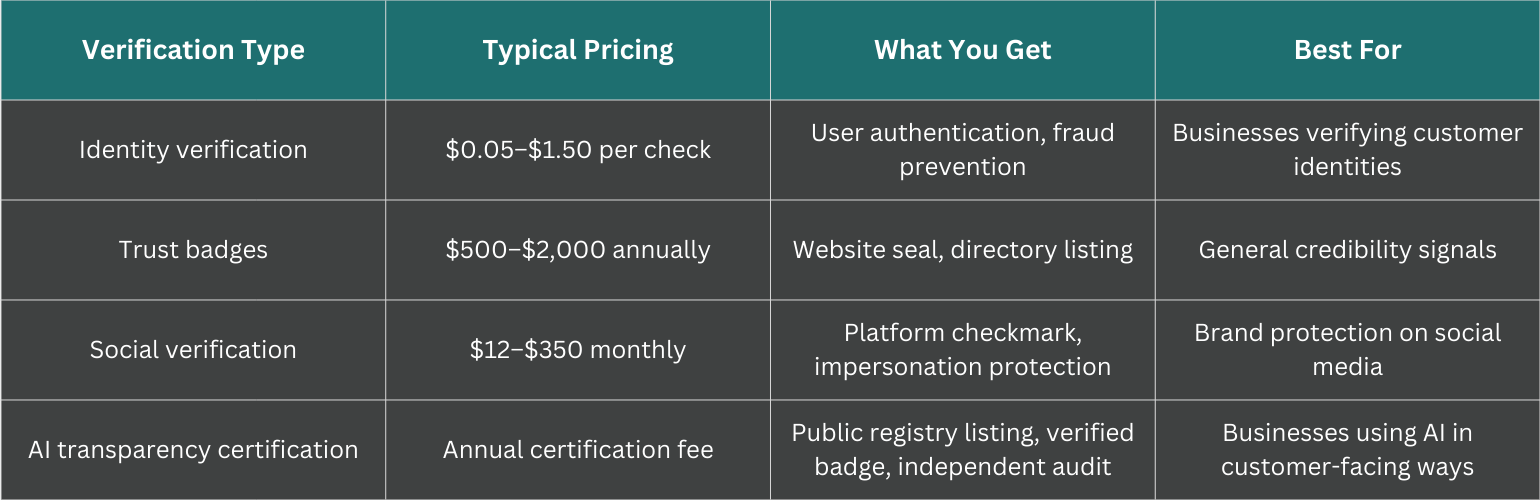
Pricing typically runs $0.25 to $1.50 per verification. Twilio Verify charges around $0.05 per check. IDWise offers $1 per verification with a $49 monthly minimum. The more verifications you run, the lower your per-unit cost tends to be.
Trust badges and seal programs
Trust badges are visual seals you display on your website. They signal security, legitimacy, or membership in a verified business network.
Programs like TrustArc and the Better Business Bureau charge annual fees, usually $500 to $2,000 depending on business size. In return, you get a badge to display plus a listing in their directory.
Social media verification
Social verification gives you the blue checkmark on platforms like Instagram, Facebook, or X. It protects your brand from impersonation and adds a layer of credibility.
Meta Verified costs $11.99 monthly on web or $14.99 through mobile apps. Business tiers go higher, reaching $349 monthly for premium features.
AI transparency certification
AI transparency certification is a newer category. It involves an independent evaluation of how your business uses AI and whether you're transparent about it with customers.
This type of verification matters because 84% of consumers want mandatory labeling when AI affects their experience. A self-reported badge doesn't carry the same weight as independent certification that examines your actual practices.
Factors that affect verification pricing
Pricing varies significantly even within the same category. Several factors determine what you'll actually pay.
Verification volume and frequency
Per-verification services scale with usage. If you verify 100 users monthly, you pay for 100 checks. If you verify 10,000, you pay for 10,000, though volume discounts often apply at higher tiers.
For subscription-based certifications, volume matters less. You pay the same annual fee whether you have 1,000 or 100,000 website visitors.
Business size and audit complexity
Larger organizations with more AI touchpoints, data flows, or customer interactions require deeper evaluation. A small e-commerce site has simpler verification requirements than a multinational financial services company.
More complexity means more time spent on evaluation, which translates to higher cost.
Certification depth
Basic badges often rely on self-reported information. You fill out a form, pay a fee, and receive a seal.
Comprehensive certifications involve actual audits. Someone reviews your practices, policies, and disclosures. This deeper verification costs more, but it also carries more weight with customers and regulators.
Renewal and ongoing monitoring
Most certifications aren't one-time purchases. You'll pay annually to maintain your verified status.
Some programs include continuous monitoring between renewals. Others simply re-evaluate you each year. Either way, factor renewal costs into your total investment.
Website verification pricing comparison
What verification fees include
Understanding what you're paying for helps you compare options fairly. Not all verification programs deliver the same value.
Assessment and evaluation process
Every verification involves some form of assessment. Identity services run automated checks against databases. Certification programs may involve document review, interviews, or technical audits.
The depth of assessment directly affects the credibility of the verification. A quick automated check doesn't carry the same weight as a thorough evaluation of your actual practices.
Public registry listing
Some certifications include listing in a searchable public registry. This allows customers to independently verify your status before doing business with you.
A registry listing adds accountability. Anyone can check whether your certification is current and legitimate, which builds confidence in a way that a badge alone cannot.
Trust badges for your website
Most programs provide visual assets to display on your site. Badges typically appear at checkout, on your homepage, or wherever trust matters most.
The badge signals credibility at the moment of decision, when visitors are choosing whether to buy, sign up, or share their information.
Support and compliance updates
Better programs include ongoing support. As standards evolve or regulations change, you get guidance on staying current.
This matters especially for AI-related certifications. The EU AI Act and Colorado AI Act are creating new requirements, and programs that help you navigate changes deliver ongoing value beyond the initial certification.
Is paying for website verification worth it
The real question isn't cost. It's return on investment.
Verification pays off when it removes friction from your customer's decision. If visitors hesitate because they're unsure about your legitimacy or AI practices, a verified badge can tip them toward conversion.
Higher conversions: Visitors trust verified businesses more, which translates to more completed purchases and sign-ups
., with trust badges increasing conversions by up to 42%.Customer loyalty: Transparency builds repeat business. Customers who trust you come back.
Competitive edge: When competitors lack verification, you stand out.
Regulatory readiness: Getting certified now prepares you for upcoming AI disclosure requirements.
The businesses seeing the best return are those where trust directly affects buying decisions. Financial services, healthcare, e-commerce, and any company using AI in customer-facing ways tend to benefit most.
How to choose the right verification for your business
Match your verification choice to what you're trying to prove and who you're proving it to.
If you verify user identities as part of your product or service, per-verification services like Twilio or IDWise make sense. You pay based on actual usage, and costs scale with your business.
If you want general credibility signals for your website, trust badge programs from established organizations add legitimacy. Visitors recognize the seals and associate them with trustworthiness.
If you use AI and want to prove transparency, AI transparency certification addresses the specific concern consumers have about AI. It also positions you ahead of regulatory requirements that are already taking effect in some jurisdictions.
Think about your customer's biggest hesitation. Then choose verification that directly addresses it.
Turn trust into your competitive advantage
Trust is proven, not claimed. In a market where every company says they're trustworthy, independent verification separates you from the noise.
The businesses winning customer confidence are those willing to be evaluated by a third party and listed in a public registry. That level of transparency converts skeptical visitors into confident customers.
SiteTrust certification provides exactly this kind of verifiable trust signal. Our public registry allows consumers to check your AI transparency status before they decide to buy, building confidence at the moment it matters most.
Ready to prove your AI transparency? Get certified for AI transparency with SiteTrust.
Frequently asked questions about website verification costs
How much does it cost to get verified on a website?
Costs range from a few cents per identity check to several hundred dollars annually for certification programs. The price depends on the verification type and provider you choose.
What is a verification fee?
A verification fee is the charge for confirming identity, credentials, or business practices through a third-party service. It covers the cost of the assessment and any ongoing benefits like badge display or registry listing.
Are there free website verification options available?
Some basic trust badges offer free tiers with limited features. However, comprehensive certifications that include independent audits typically require payment.
How long does the website verification process take?
Automated identity checks take seconds. Certification programs involving evaluation can take days to weeks depending on the complexity of your business and the depth of the audit.
Do website verification costs include annual renewal fees?
Most certification and badge programs charge recurring fees, either monthly or annually, to maintain verified status. One-time verification is less common for business certifications.
What is the difference between website verification and certification?
Verification confirms a single fact, like identity or domain ownership. Certification involves broader evaluation of practices, policies, or compliance standards, and typically carries more weight with customers and regulators.
Ready to become a founding member?
Apply for certification todayFree AI tools
Assess your AI readiness
Use these quick assessments to spot trust, governance, and disclosure gaps.