How to Build Business Trustworthiness in an AI-First Economy
Customers decide whether to trust your business in seconds. That snap judgment affects whether they buy, return, or recommend you to others.

Trust has always mattered, but AI changes the equation. Customers now have questions about data use, automated decisions, and whether what they see online is even real - concerns increasingly reflected in emerging AI regulations. This guide covers what makes a business trustworthy, how AI is shifting customer expectations, and practical ways to build trust that converts skeptical visitors into confident buyers.
Why business trustworthiness drives revenue
Business trustworthiness is the belief that a company will act ethically, competently, and reliably with customers, employees, and partners. When customers trust a business, they buy more often, stay longer, and recommend it to others. When they don't, they leave—often without saying why.
Trusted businesses convert more visitors into buyers because skeptical shoppers hesitate less - 40% of consumers stopped their buying decision at one point because they didn't trust the company. They also retain customers longer because loyalty follows trust. In crowded markets where products look similar, trust becomes the deciding factor.
Higher conversions: Visitors who trust you complete purchases instead of abandoning carts
Stronger loyalty: Customers return to businesses they trust rather than shopping around
Competitive separation: When products seem equal, trust tips the decision
Think of trustworthiness as an invisible sales team working around the clock. It reduces the friction that slows down buying decisions (93% of business executives agree that the ability to build and maintain trust improves the bottom line). Without it, even great products struggle to find traction.
What makes a business trustworthy
We can look at trustworthiness as four traits working together. Weakness in any one undermines the others.
Competence
Competence means having the skills and ability to deliver what you promise. A restaurant with friendly service but terrible food isn't competent. Neither is a software company with impressive features that crash constantly.
Customers notice gaps between claims and reality. They might not articulate it as "competence," but they feel it when expectations don't match experience.
Reliability
Reliability means following through consistently, not just when it's convenient. One late delivery might be forgiven. A pattern of late deliveries destroys trust.
Here's the thing: customers remember disappointments longer than they remember good experiences. Reliability is about building a track record that earns the benefit of the doubt.
Integrity
Integrity means doing the right thing even when no one is watching. It shows up in how you handle mistakes, how you treat customers who can't help your bottom line, and whether your actions match your stated values.
Customers can sense when a company's behavior doesn't align with its messaging. That misalignment creates unease, even if they can't pinpoint exactly why.
Transparency
Transparency means proactively sharing information customers care about—before they ask. In the AI era, transparency has become especially important because customers want to know how their data is used and whether AI influences decisions that affect them.
Transparency isn't just about disclosure. It's about making information accessible and understandable, not buried in legal documents nobody reads.
How AI is changing customer trust
AI introduces trust concerns that didn't exist five years ago. Customers now wonder how their data is being used, whether AI is making decisions about them, and if the content they see online is even real.
The challenge is that AI is invisible. Customers can't see how it works or where it's integrated into your business. A recommendation engine, a chatbot, a fraud detection system - all of these run in the background without customers knowing. This invisibility creates skepticism, even toward companies with good intentions.
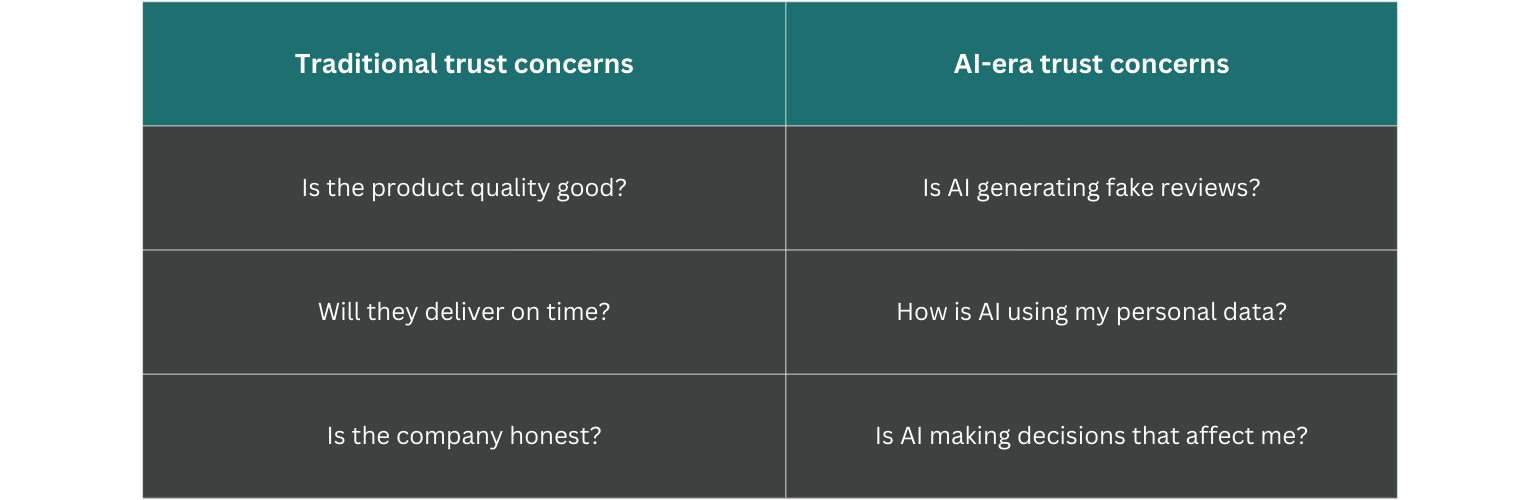
Businesses using AI now face higher expectations. Customers don't just want to know what you do - they want to understand how AI fits into the picture. The companies addressing this proactively are building trust while others are losing it.
Five strategies to build business trustworthiness
Understanding trustworthiness is one thing. Building it is another. Here are five approaches that work.
1. Follow through on every promise
Broken promises destroy trust faster than anything else. Yet this is where most trust breaks down—not through dramatic failures, but through small, accumulated disappointments.
Be careful about what you promise. If your website says "ships in 2 days," that's a promise. If your sales team says, "We'll follow up tomorrow," that's a promise. Every unmet commitment chips away at credibility, even when customers don't complain directly.
The fix is straightforward: promise less, deliver more. Under-promise and over-deliver isn't just a cliché. It's a proven method of how trust compounds over time.
2. Be open about how you use AI
Proactively disclose AI use before customers ask. Explain what AI does in your business and, just as importantly, what it doesn't do.
For example, if AI helps recommend products but humans make final decisions on customer service issues, say so. If AI processes applications but a person reviews flagged cases, explain that. Customers appreciate knowing where the human element remains.
This kind of openness turns AI from a source of suspicion into a demonstration of transparency. The businesses winning trust are those treating AI disclosure as an opportunity rather than a liability.
3. Get independent verification
Self-claimed trust isn't enough anymore. Anyone can say "we're trustworthy" on their website. Third-party certification proves your practices have been evaluated by someone objective, with options ranging from basic commitment to comprehensive verification through three tiers of certification.
Think about it from the customer's perspective. "We're trustworthy" is a claim. "We've been independently certified" is evidence. The difference matters, especially for skeptical buyers who've been burned before.
Tip: Independent certification works best when customers can verify it themselves through a public registry. Not just a badge on your website that could mean anything.
4. Educate customers about your practices
Share knowledge freely. Explain how your business works in plain language that doesn't require a law degree to understand.
Customers trust businesses that help them understand. When you demystify your processes, you reduce the uncertainty that breeds skepticism. This is especially true for AI, where most people have limited technical knowledge but genuine concerns.
Education builds trust because it signals confidence. Companies hiding behind complexity often have something to hide. Companies explaining things clearly demonstrate they're comfortable with scrutiny.
5. Respond to concerns quickly
Fast, honest responses build trust. Silence destroys it. Even if you don't have an immediate solution, acknowledging the concern matters.
Customers want to know they've been heard. A quick response that says "we're looking into this" builds more trust than a perfect response that arrives three weeks later. Speed signals that you care.
Why transparency is the foundation of AI trust
Of all trustworthiness traits, transparency matters most in the AI era. Here's why: AI is invisible to customers, so they can't evaluate it themselves., and 81% of consumers think the information collected by AI companies will be used in ways people are uncomfortable with.
With a physical product, customers can see quality. With a service, they can experience it directly. With AI, they're trusting something they can't observe. This makes transparency the only way customers can assess whether your AI practices align with their expectations.
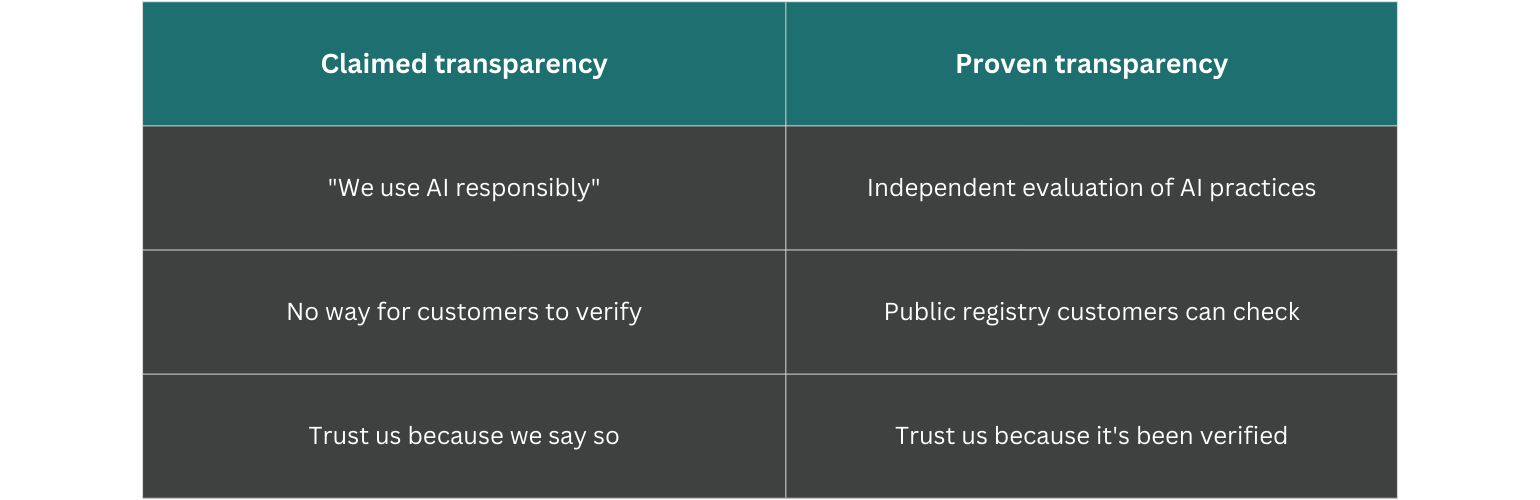
The businesses winning customer trust are those making their AI practices verifiable through certification best practices, not just visible. There's a difference between saying you're transparent and proving it.
How to prove trustworthiness through certification
Trust works best when it's verifiable. Certification provides that proof.
Trust badges vs independent certification
Generic trust badges are self-applied—anyone can put one on their website. Independent certification means a third party has actually evaluated your practices against defined standards.
Customers increasingly know the difference. A badge without verification behind it carries less weight than it used to. People have seen too many meaningless seals to take them at face value.
Public registries for consumer verification
A public registry lets anyone verify a company's certification status before buying. This shifts trust from "take our word for it" to "check for yourself."
When customers can independently confirm your certification, their confidence increases. They're not relying solely on your claims—they're verifying through an objective source. SiteTrust's public registry serves exactly this purpose, allowing consumers to confirm AI transparency certification before they decide to trust an organization.
What certification signals to customers
Certification tells customers you've invested in doing things right. It signals accountability—you're willing to be evaluated and held to a standard.
For skeptical buyers, this visible signal reduces hesitation. It answers the question "Can I trust this company?" with evidence rather than promises. In a market full of claims, evidence stands out.
Ready to prove your AI transparency? Get certified for AI transparency with SiteTrust.
Build trust that converts skeptics into customers
Trustworthiness isn't just nice to have—it's a competitive advantage that wins business. In the AI era, the gap between trusted and untrusted companies will only widen as customers become more aware of AI's role in their lives.
The businesses that prove their trustworthiness will outperform those that just claim it. Customers have too many options to take chances on companies they're unsure about. When trust is verified rather than assumed, skeptics become buyers.
Get certified for AI transparency with SiteTrust.
FAQs about business trustworthiness
What is trustworthiness in business?
Business trustworthiness is a company's demonstrated ability to be relied upon by customers. It's built through consistent actions that show competence, reliability, integrity, and transparency over time - not through marketing claims.
What are the 4 components of trustworthiness?
The four components are competence (ability to deliver), reliability (consistency in delivering), integrity (ethical behavior), and transparency (openness about practices). All four work together, and weakness in one affects the others.
What are the 4 C's of creating trust?
The 4 C's are competence, consistency, character, and communication. This framework overlaps with trustworthiness traits and emphasizes how businesses demonstrate trust through observable actions rather than stated intentions.
How can customers verify if a business is trustworthy?
Customers can look for independent certifications, check public registries, read verified reviews, and see if a company proactively discloses its practices. The key is looking for verifiable evidence rather than self-made claims that anyone can put on a website.
How does AI transparency affect business trust?
AI transparency directly affects trust because customers are increasingly concerned about how AI uses their data and makes decisions. Businesses that openly disclose their AI practices reduce skepticism and build confidence with buyers who might otherwise hesitate.
Ready to become a founding member?
Apply for certification todayFree AI tools
Assess your AI readiness
Use these quick assessments to spot trust, governance, and disclosure gaps.