Does your website chatbot have to tell visitors it's AI?
If a chatbot answers your visitors, they should know it isn't a person. Here is why disclosure is now an enforcement issue, and how to check your own site.
Does your website chatbot have to tell visitors it's AI?
Plan on it, and check what yours says today. Since 2019, California law has barred using an undisclosed bot online to mislead people about what it is in order to make a sale. State attorneys general now treat a chatbot that passes as human, or quietly shares chats, as deception. What matters is whether your site tells the truth.
What counts as "undisclosed AI" on a website?
Undisclosed AI is any place your site uses AI to talk to visitors, or to make decisions about them, without saying so. The most common one is the chat bubble in the corner.
Many business owners added a chat tool to answer questions after hours or book appointments. Some of those tools now run on AI. Some came bundled with a website platform, a scheduling tool or a marketing plugin, and the owner never chose AI at all.
Visitors type real things into those boxes: their names, their problems, sometimes their health or legal questions. They deserve to know who, or what, is answering.
Why is this a risk right now?
Because the people who enforce consumer protection laws are paying attention, and they don't need a new AI law to act.
California's bot law is already in place. Since July 1, 2019, California law has barred using a bot online to mislead a person about its artificial identity in order to drive a sale. A clear, conspicuous disclosure that it's a bot takes the user out of it (Business and Professions Code 17940 to 17943).
Attorneys general are naming chatbots. On November 6, 2026, West Virginia's attorney general announced a suit against Snap, alleging its My AI chatbot told users it was not an AI and shared conversations with outside partners. These are allegations, and nothing has been decided. The theory is what matters for everyone else: a bot that claims to be human, or a privacy notice that doesn't match what the bot does with conversations, is treated as plain deception.
The offices changed. After the November 3 elections, winners in several attorney general races named AI chatbots, automated decisions and deepfakes as priorities for 2027 (WilmerHale, Nov 6, 2026).
None of this means your business has done anything wrong. It means the question will be asked, and the answer should already be written down.
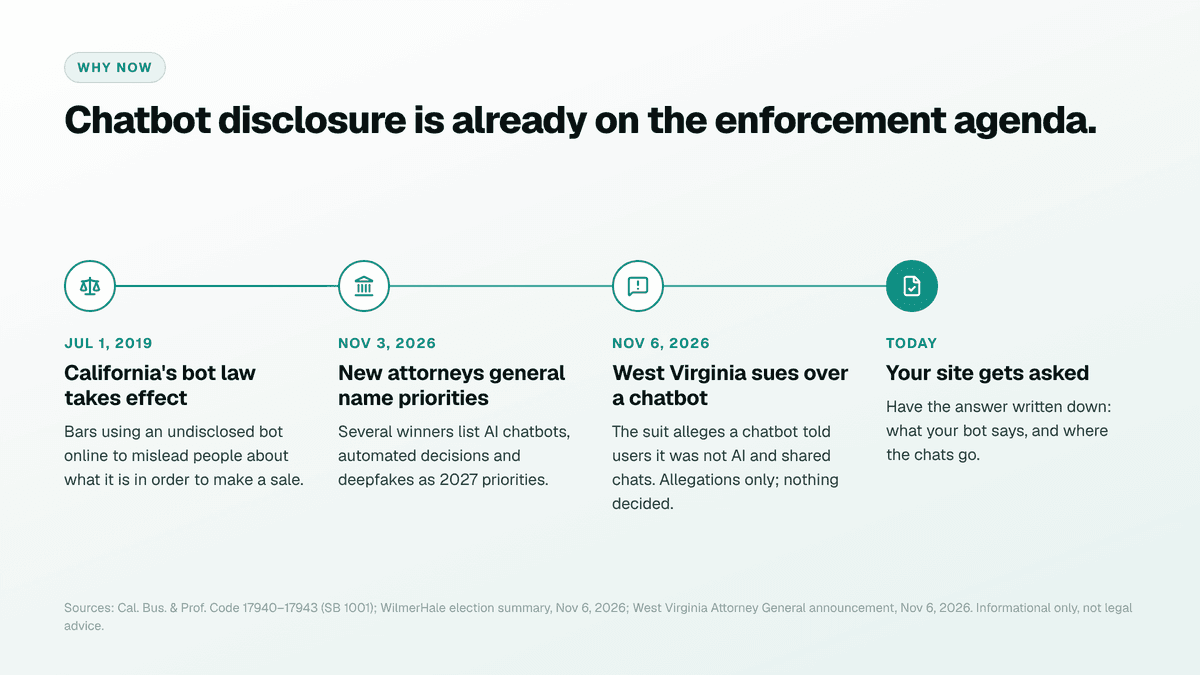
Image description: Timeline: California's bot disclosure law took effect July 1, 2019; new attorneys general named AI chatbots as priorities after the November 3, 2026 elections; West Virginia announced a suit over a chatbot on November 6, 2026 (allegations only).
"It's just a chat widget." Why would anyone care?
Because the visitor trusted your name, not the widget's.
When someone asks your site a question, they believe your business is answering. If a bot answers in your voice and never says it's a bot, the visitor finds out later, and they remember who they trusted.
I'll say it plainly: using AI in your name without saying so is faking. Using AI isn't the problem. Hiding it is.
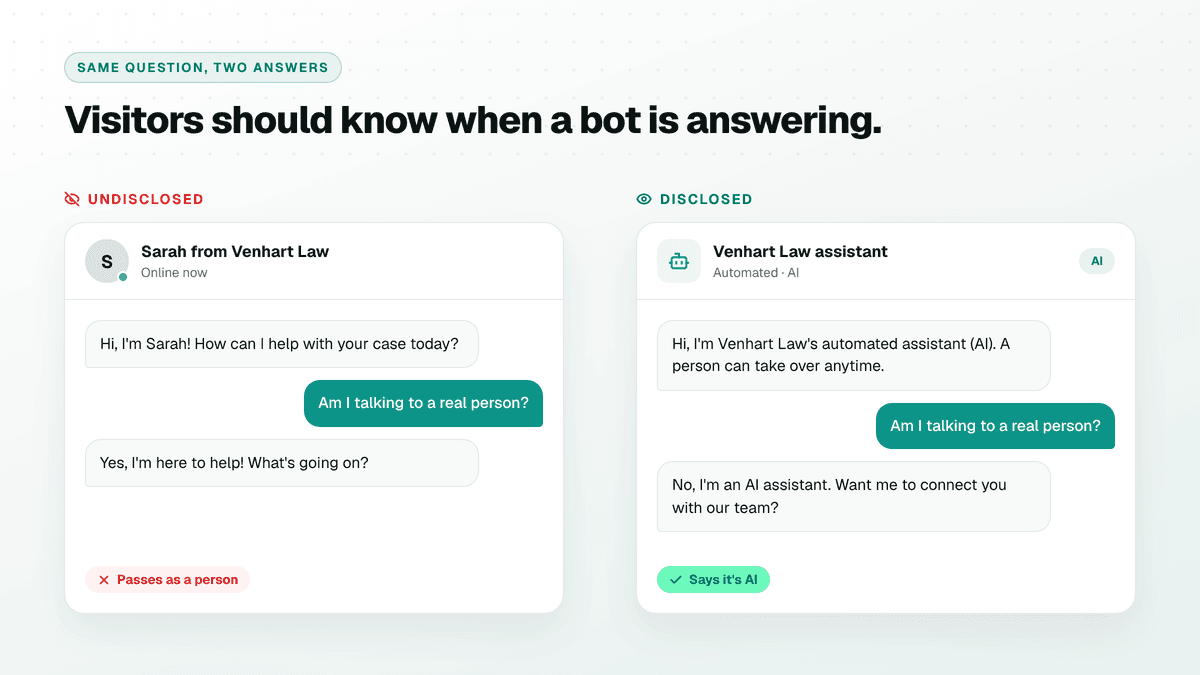
Image description: Two chat windows answer the same question, "Am I talking to a real person?" The undisclosed bot, named Sarah, says yes. The disclosed assistant says it is an AI and offers to connect the visitor with the team.
Who should be paying attention?
Anyone whose site has a chat box, an AI assistant, or an automated intake form. It matters most where trust is the product:
Law firms using chat for intake.
CPAs and financial advisors answering client questions online.
Insurance agencies quoting or screening through a bot.
Medical and dental practices booking or triaging through chat.
Agencies that install chat tools on client sites.
If a visitor could reasonably think a person is on the other end, this applies to you.
How do you check your own site?
You don't need to be technical. Open your site on your phone and look at it the way a visitor would.
Find every AI touchpoint. Chat bubbles, booking assistants, "ask us anything" boxes, automated email replies. Who added each one, and does it use AI?
Read the first message. Does the bot say it's automated before the visitor types anything? Does it ever use a person's name or photo?
Ask it directly. Type "Am I talking to a real person?" Write down exactly what it says.
Match the policy to the tool. Does your privacy notice say which chat vendor you use and what happens to conversations? Ask the vendor if they keep chats or use them to train their AI.
The free SiteTrust Scan checks your site from the outside and gives you a dated summary of what it found, so you have a record, not a guess.
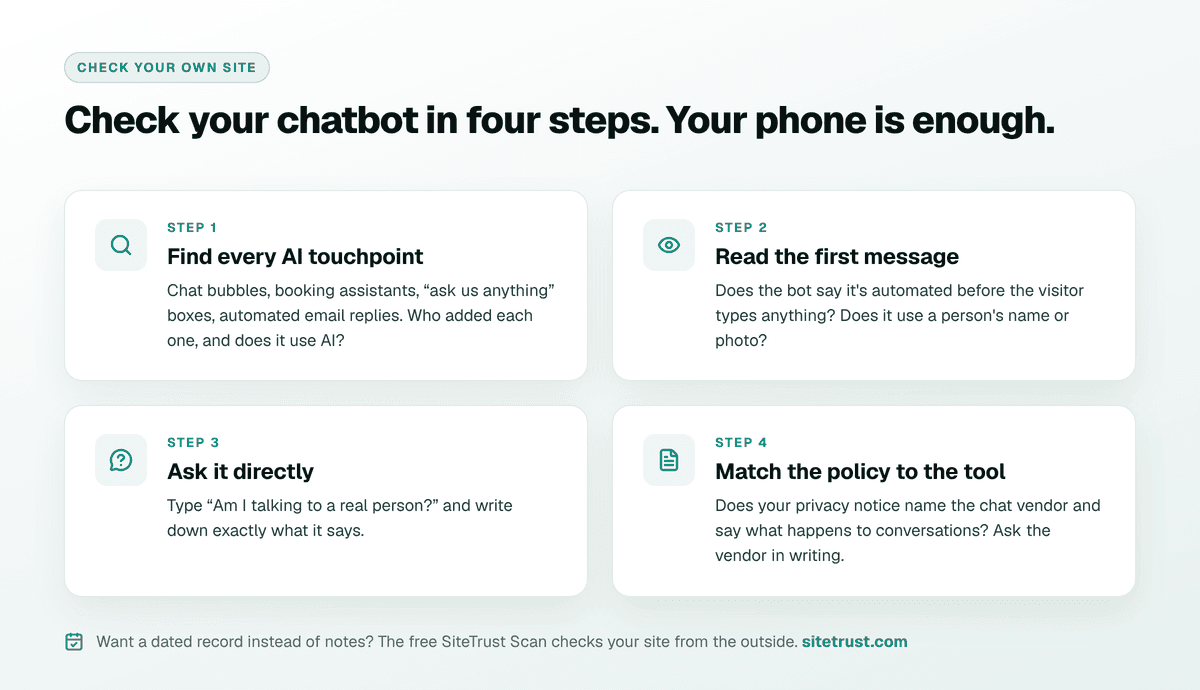
Image description: Four steps to check your chatbot: find every AI touchpoint, read the first message, ask it directly if you are talking to a real person, and match your privacy notice to the tool.
What does "handled" look like?
The bot says it's a bot, up front, every time. A visitor who wants a person can reach one. Your privacy notice describes what the chat vendor does with conversations, and it matches what actually happens. And when a client, a regulator or a reporter asks how your site uses AI, you can show them the answer in writing.
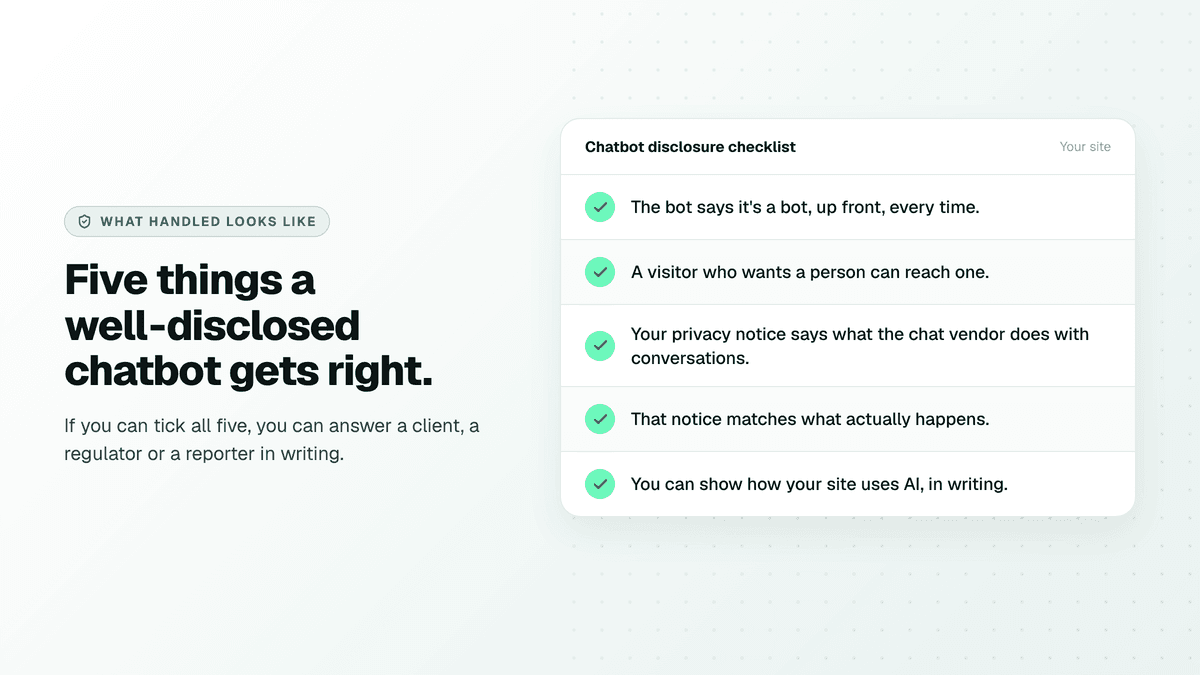
Image description: Chatbot disclosure checklist: the bot says it is a bot up front, a visitor can reach a person, the privacy notice says what the chat vendor does with conversations, the notice matches what happens, and you can show how your site uses AI in writing.
FAQ
Do I have to disclose that my website chatbot is AI?
We can't answer that for your business, and no tool can. What we can say: California has a bot disclosure law in place since 2019, and state attorneys general are bringing deception claims against chatbots that pass as human. Clear disclosure is the simple way to take the question off the table. Your lawyer can tell you what applies to you.
What if the chatbot came with my website platform?
The vendor built it, but it speaks on your site, in your name. Find out whether it uses AI, what it says about itself, and where the conversations go.
Is a line in my privacy policy enough?
Probably not on its own. Visitors read the chat window, not the policy. Disclose in the chat itself, and make sure the policy matches what the tool does.
Does my chatbot vendor keep the conversations?
Many do, and some use them to improve their AI. Ask in writing, keep the answer, and make sure your privacy notice says the same thing.
Run the free scan
See what your site tells visitors, and what it does. Run the free scan at sitetrust.com
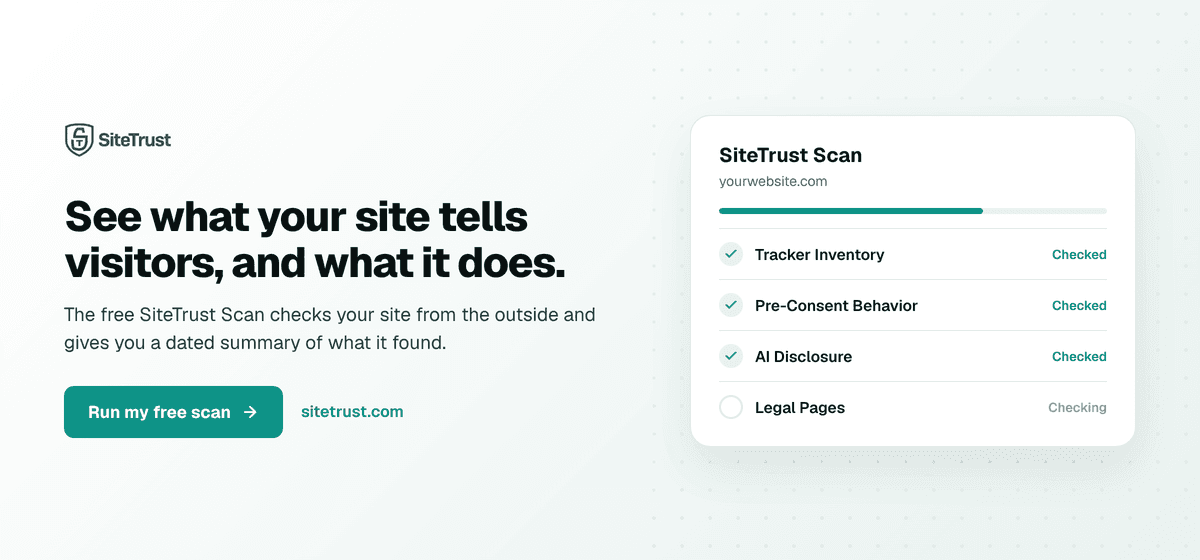
Image description: Run the free SiteTrust Scan to see what your site tells visitors and what it does. The scan checks trackers, consent behavior, AI disclosure and legal pages.
Hidden risks, handled. SiteTrust, earned. What remains, covered.
Informational only and not legal advice. Sources: California Business and Professions Code 17940 to 17943 (SB 1001, effective July 1, 2019); West Virginia Attorney General, suit against Snap Inc., announced Nov 6, 2026 (EIN Presswire; MLex, Nov 2026); WilmerHale election summary, Nov 6, 2026.
Ready to become a founding member?
Apply for certification todayFree AI tools
Assess your AI readiness
Use these quick assessments to spot trust, governance, and disclosure gaps.